What it costs, and how the free year works
The price is on this page rather than behind a form, because a number a head of department can read without talking to anybody is itself a reason to keep reading. The whole of it, with a calculator, is at /pricing; this page says how it works.
The free year
A college’s first 365 days are free, with up to 50 students during them. It is the whole platform and not a cut-down one, staff accounts are not counted, and nothing is charged and no card is asked for to start. Sign up with an institutional address and it runs from that day.
An academic year does not start in September everywhere, so if yours ends at a different time we will move the end of your free year to line up with it. Ask on the free early access call or email us; it costs nothing and does not shorten it.
Ordering early does not shorten it either: the first paid year begins when the free one ends, and a college that orders before the decision date agreed when it started gets 20% off that first paid year.
The fair-use limits below apply to the free year as they do to a paid one.
The price
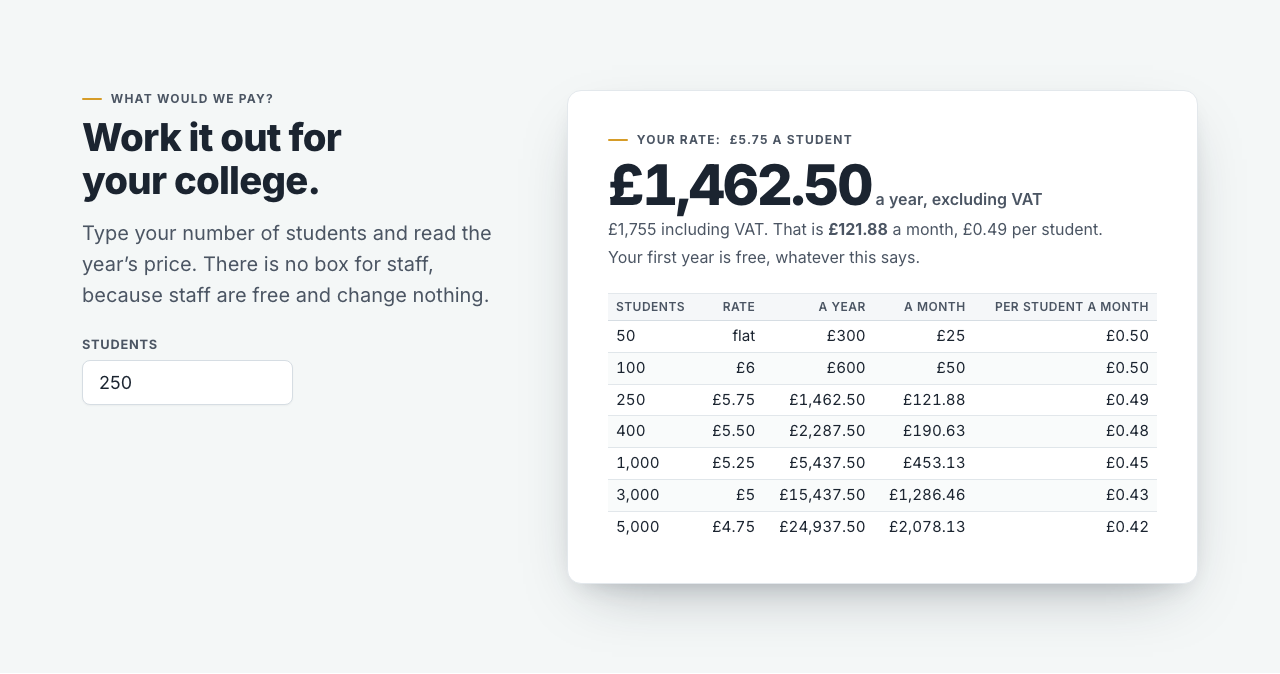
In pounds, a paying college pays £300 a year for its first 50 students, however few it has, which is £25 a month. Every student after that is priced per year at the rate for the range they fall in, and each rate is 25p less than the one before: £6 for students 51 to 100, £5.75 to 250, £5.50 to 400, £5.25 to 1,000, £5 to 3,000, £4.75 to 5,000 and £4.50 beyond. The ranges have no names, because they are rates rather than plans and every college gets the same platform. Staff are free however many there are, and every price in pounds is excluding VAT.
So a college of 100 pays £300 for its first 50 and £6 for each of the next 50, £600 a year. A college of 250 pays £1,462.50, about £122 a month. A college of 1,000 pays £5,437.50, about 45p a student a month, and the average falls at every size.
A three-year commitment is 10% off each year at a price that does not move.
Prices in your own currency
The figures above are the price in the United Kingdom. Each of 213 countries has a price of its own, set in its own currency where that is one of the 21 we bill in and in US dollars otherwise, and never a conversion, so a change in exchange rates changes nothing you have been quoted. Prices follow what a country can pay, from US$2 a student in the lowest. The website shows the price for the country you are visiting from; when that cannot be told, the language you are reading in decides (yen for Japanese, euros for French and Spanish, pounds otherwise), and a country with no price of its own sees the US price. Every country’s price is listed in Part D of the terms. The pricing page has a menu for looking at another currency’s own price, which changes only what the page shows.
Every price falls by range at the same sizes as above, each student priced in the range they fall into: in Japan, for example, JP¥35,000 a year for the first 50, then JP¥700 for each student falling to JP¥525 above 5,000; in the United States US$450, then US$9 falling to US$6.75; and in India US$100, then US$2 falling to US$1.50. The free year and the discounts are the same everywhere.
A college is billed the price of the country it signed up from, in that country’s currency, and its Settings page shows which currency. We will move a college to another currency on request, from its next bill, at that currency’s own price. VAT is added only to prices in pounds; a price in any other currency carries no tax. A site administrator makes that move from the college’s settings and it is written to the admin log; a college admin can see the currency but not change it. A college cannot be opened from a country on our own fixed list of places we do not sell to: Afghanistan, Belarus, Cuba, Iran, Myanmar, North Korea, Russia, Sudan, Syria and Venezuela. That list is ours, whatever PayPal allows, the sign-up refuses before anything is made, and every page can still be read from there.
Everything is included, on a fair-use basis
There is nothing to add on. AI help for staff and the AI tutor for students, deploying apps with their databases and cloud stacks, and running and testing code are all in the price. Each is metered and capped per person by the platform’s own limits, which a college may raise at its own cost: the AI credits are on the Settings page, and the app and runner allowances are on the pages that use them. We never raise a limit on a college’s behalf and bill it afterwards.
How billing works
Once a year, in advance, by invoice against a purchase order; or by card through PayPal, where the same price is taken a twelfth at a time, each month on the students you have that month. The paid year starts when the free one ends, and we will align it to your academic year on request.
The invoice counts the students on the platform on the day the year starts. At the end of the year it is priced again on your average number of students across the year, each student counted for the days their account existed and was not suspended, and staff never. Students who joined are charged for the days they were there and students who left are credited for the days they were not; the first 50 are still one price. The difference is added to your renewal invoice or taken off it, and refunded if you do not renew.
Card payment is a PayPal plan for each price, a plan’s price being fixed at PayPal. A price with no plan set up is told card payment is not set up and pays by invoice, and is never put on another price’s plan.
Your Billing page shows the count a year was invoiced on and every account behind it, and, as the year goes on, its average so far and what the year end would add or take off if nobody joined or left from today, so an invoice can be checked against your own records.
When the free year ends
Nothing is switched off behind your back. Today we monitor the free year and its 50-student allowance by hand and get in touch with a college as it nears the end, and nothing shuts a college out automatically when either runs out.
The platform does know three stages, worked out from dates each time somebody signs in rather than by a timer: normal; suspended, when only the college admin can sign in, so the one person who can add a payment method still can; and blocked sixty days later, when nobody can. The automatic move between them is switched off for now. A site administrator can still suspend or block a college by hand, extend a free year, or change the number of accounts a college may hold. A college with a live card subscription behind it never ages out.
Learning on your own
An individual account is free for ever, with the playground, your own files and the free lessons other colleges have shared. It is not a trial.
Questions people ask
- Is there a minimum contract?
- A year, and no minimum size: £300 covers a department’s first 50 students however few it has. There is no contract during your free year, or for an individual account.
- What counts as a student?
- A student account, for the days it existed and was not suspended. The invoice is raised on the students on the platform the day the year starts, and the year is settled at its end on the average across it. Staff are never counted, at any size, and they do not count against the free year either.
- Do we need a purchase order to start?
- No. The free year needs no card and no paperwork at all.
- What does fair use mean?
- That AI, deploying and running code are included up to the per-person limits the platform applies, and that a college wanting more than they allow buys more at a rate agreed in writing rather than being billed a surprise.
- What happens when the free year ends?
- Today we monitor it by hand and get in touch as it nears the end. Nothing shuts a college out automatically, and staying on means choosing a payment route: an invoice or a card.
- Can we pay in our own currency?
- In any of the 21 currencies the price is set in. A college is billed in the one it signed up in, and we will change it on request.