Practice files: a student’s own work, outside any module
Not everything a student writes should be homework. Practice files are theirs: any language, not part of a module and not marked. They open from Build on the bar.
What they are for
Trying the thing you just showed them. Working through a book. Keeping the version that worked before they changed it. It is the difference between a platform for setting work and a place to learn.
Somebody learning on a free personal account, and a college’s admin, finds two files here the first time: a Python program to press Run on, with a test beside it, and a flowchart of that same program. They are ordinary files, to change or delete, and once deleted they do not come back.
Starting one
Pick what to make from the cards at the top, one for each kind: Python, Java, Go, C, C++, C#, Haskell, OCaml, R, Ruby, PHP, Rust, Kotlin, Prolog, JavaScript, TypeScript, Bash, a web page, SQL, a Mermaid diagram or a whiteboard. One press makes it and opens it, with a name like untitled-python. Name it once there is something in it: press the pencil beside the name at the top of the editor.
There is no upload. Paste what you already have into the editor; to take your work away, download it.
A file holds up to 64 KB, and a name can use letters, numbers, dots, dashes and underscores. There is no card for a Linux terminal, which has no file behind it: the playground is where to practise one.
How many you can keep
An account at a college has no limit on how many practise files it keeps. A free personal account keeps up to 100, so that Practice is a place to practise rather than somewhere to store files, and the page shows how many you have beside the list, as in “12 of 100 files”, before you reach it.
At the limit, starting another file is refused with a sentence saying so; delete one you no longer need to make room. Saving a file you already have is never refused.
The same editor as everything else
The same languages, the same Run, the same tests. A practise file can carry a data file too, which is what makes it useful for anything with input.
Python and Bash files open with a test beside the program, which is theirs to change. Any language that has a package manager has its package file at the top of the tree, requirements.txt or pom.xml for example, saved with the work; Bash and SQL have none.
Finding, downloading and moving files
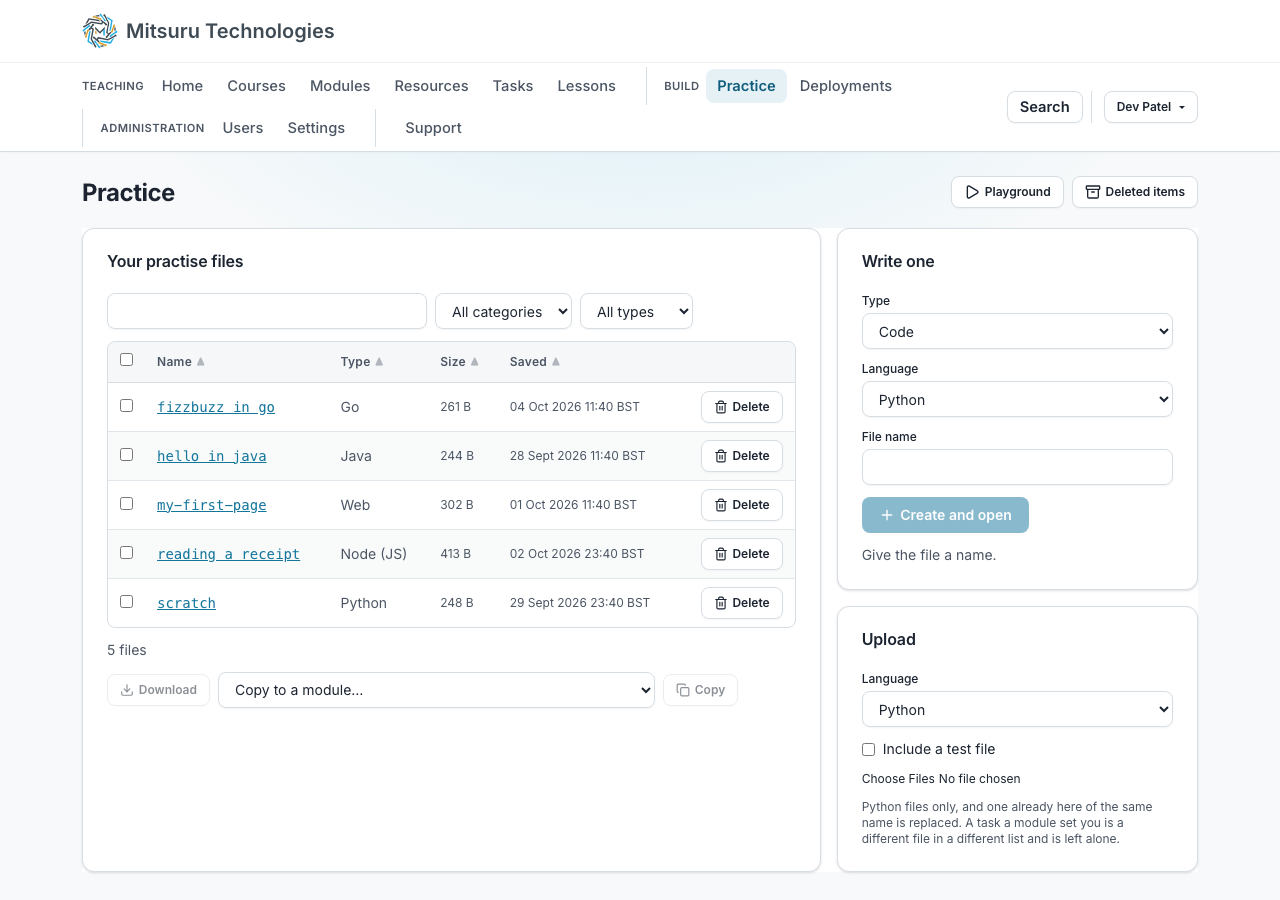
Every file can be renamed or deleted, and downloaded on its own or several at once as a zip. The list searches by name, shows ten to a page, filters by Category and Type, and sorts by Name, Type, Size or Saved. Under it a count reads “12 files”, or “3 of 12 files” once a search or filter has narrowed the list. A member of staff can also copy a practise file onto a module as a task, for something they wrote for themselves first.
Questions people ask
- Do practise files count towards our bill?
- No. The bill counts accounts, not files.
- Can a teacher see them?
- No. They are the student’s own, and nothing about them appears on a module.